.png&w=128&q=75&dpl=dpl_AxpVEEXprQ7vEtsWEYpiaq8VjpYR)
.png&w=96&q=75&dpl=dpl_AxpVEEXprQ7vEtsWEYpiaq8VjpYR)
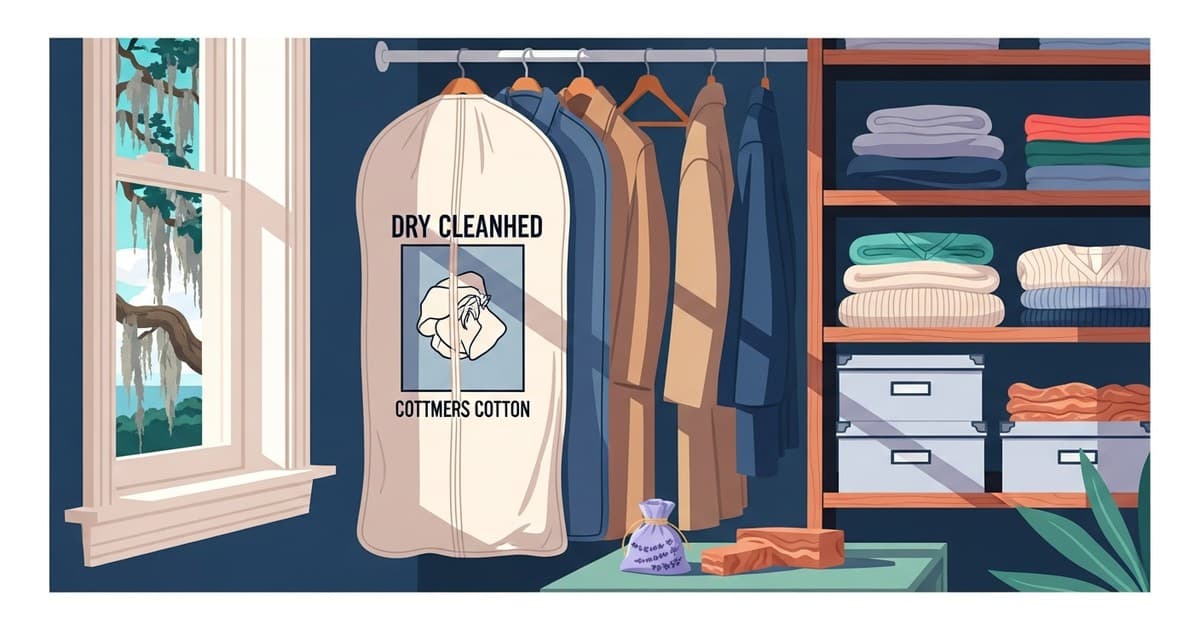
By early May in Savannah, the heavy wool coats and cashmere sweaters that carried you through January have already been pushed to the back of the closet. But before you tuck them away for the long, sticky Lowcountry summer ahead, the way you store those freshly cleaned garments matters just as much as the cleaning itself. Coastal Georgia's humidity, salt air, and warm temperatures can quietly destroy a beautifully cleaned wool blazer in a matter of weeks if it's stored incorrectly. As Savannah's family-owned dry cleaners since 1910, we've helped homeowners across Ardsley Park, the Historic District, and Isle of Hope protect their seasonal wardrobes for over a century — and the right storage routine starts the moment your garments leave our shop.
Why Post-Cleaning Storage Matters in Savannah's Climate
Savannah's coastal climate is uniquely tough on stored clothing. With average summer humidity above 75% and salt-laden air rolling in from the marshes, mold spores, mildew, and fabric-eating insects thrive in any closet that isn't properly prepared. Even a perfectly dry-cleaned coat can develop yellowing, musty odors, or moth damage if it's stored in conditions that work against it.
The reason professional dry cleaning is the essential first step is simple: invisible body oils, food residue, perfume, and sweat are exactly what attract moths, silverfish, and carpet beetles. Storing a "lightly worn" sweater without cleaning it is like leaving an open invitation for pests. For a deeper look at why this step is non-negotiable, see our companion guide on why you must clean before you store.
Once your garments are professionally cleaned, the next 24 to 48 hours are critical. That's when proper preparation, containers, and closet placement turn a clean garment into one that will emerge in October looking exactly the way it went in.
Step 1: Remove the Plastic Bag (Yes, Really)
This is the single most important — and most overlooked — rule of post-dry-cleaning storage. The thin plastic bags we use at Best Cleaners are designed to protect your garments on the short trip home from our Waters Ave or Abercorn St locations. They are not meant for long-term storage.
Plastic traps moisture against the fabric. In Savannah's humidity, that trapped moisture can cause yellowing on whites, fading on dark wools, and a chemical reaction with residual cleaning agents that breaks down natural fibers over time. Silks, in particular, can develop permanent yellow streaks within a single summer.
As soon as you bring your dry cleaning home, slip the plastic off and let each garment air out for at least an hour. This allows any residual solvent vapors to dissipate and gives the fibers a chance to breathe before they're sealed away.
Step 2: Choose the Right Storage Containers
The container you choose determines whether your wardrobe survives the summer. After more than a century of helping Savannah families with garment care, here's what we recommend:
Breathable cotton or canvas garment bags are the gold standard for hanging items like wool coats, blazers, and dresses. Unlike plastic, cotton allows air circulation, which prevents mildew while still keeping dust and pests at bay. Look for natural-fiber bags with full-length zippers.
Acid-free archival boxes are perfect for folded items like cashmere sweaters, heirloom pieces, and anything you want to preserve for years. Standard cardboard contains acids that can yellow fabric over time, so investing in archival-quality boxes pays off.
Cedar chests or closets, common in older Savannah homes — especially in the Historic District and Victorian District — are excellent natural deterrents to moths. If your cedar has lost its scent over the years, a light sanding with fine sandpaper will refresh the aromatic oils without any chemicals.
Avoid vacuum-seal bags for natural fibers like wool, cashmere, silk, and down. Compressing these materials for months at a time crushes the fibers and can leave permanent creases that even our best pressing service can't fully restore.
Step 3: Pick the Right Spot in Your Home
Where you store matters as much as how you store. Skip the obvious choices: attics get dangerously hot in a Savannah summer (often exceeding 130°F), basements trap moisture, and garages cycle through extreme temperature swings that stress fabric fibers.
The ideal storage location is an interior closet on the main floor, away from exterior walls. Exterior walls in Savannah homes — particularly older homes in Ardsley Park, Starland, and Thunderbolt — are prone to condensation as outdoor humidity meets indoor air conditioning. Closets along interior walls stay more temperature-stable.
If your closet feels damp, a small dehumidifier or even reusable silica gel packets can dramatically reduce moisture. Aim for relative humidity below 55% to prevent mildew growth. Property managers handling rental units across Savannah's neighborhoods often install closet-sized dehumidifiers as a low-cost way to protect tenants' belongings — a smart move in our climate.
Step 4: Add Natural Pest Deterrents
Mothballs work, but they leave a chemical odor that can take months to fade and contain naphthalene, a substance many Savannah families prefer to avoid in homes with children or pets. Fortunately, there are gentler alternatives that align with eco friendly dry cleaning savannah values.
Cedar blocks or cedar oil sachets are highly effective against moths and add a pleasant, clean scent. Refresh them every six months with a few drops of cedar essential oil.
Lavender sachets repel moths, silverfish, and carpet beetles while leaving your wardrobe smelling like a Savannah springtime garden. They're widely available at Forsyth Farmers' Market and local boutiques.
Dried rosemary and bay leaves offer similar protection and are nearly free if you grow herbs in your yard or on your apartment balcony.
Tuck these into the corners of garment bags, between folded sweaters in archival boxes, or on closet shelves. Avoid placing any pest deterrent in direct contact with fabric — wrap them in muslin or place them in small mesh bags.
Step 5: Organize for Easy Retrieval Next Fall
A little organization in May saves a lot of frustration in October. Group garments by type — coats together, sweaters together, formalwear together — and label each container clearly. If you're storing items in multiple closets or under-bed boxes throughout your home, keep a simple inventory list on your phone.
For dual-income families juggling busy schedules across Pooler, Garden City, and Richmond Hill, this organizational step is what separates "I know exactly where my camel coat is" from "I haven't seen that wool blazer in two years." It's also a great moment to evaluate what you actually wore last winter — if a piece sat in your closet untouched, consider donating it before storage rather than after.
For pieces that need restoration before storage, our team handles deep stain removal. Learn more about our complete dry cleaning process and how we approach delicate garments.
Key Takeaways
- Always remove plastic dry-cleaning bags before long-term storage — they trap moisture and can yellow or weaken natural fibers
- Use breathable cotton garment bags for hanging items and acid-free archival boxes for folded sweaters
- Choose interior closets on the main floor — avoid attics, basements, and garages in Savannah's climate
- Keep humidity below 55% with a small dehumidifier or silica gel packets
- Skip mothballs in favor of cedar, lavender, and dried herbs for a chemical-free, family-friendly approach
- Always dry clean before storing to prevent pests and permanent stain set
Trust Savannah's Oldest Dry Cleaner with Your Seasonal Wardrobe
For more than 110 years, Best Cleaners has been Savannah's go-to family-owned dry cleaner — caring for everything from heirloom wedding gowns to everyday work coats. Our eco-friendly cleaning process uses gentle, environmentally responsible products that protect both your garments and Savannah's coastal environment, so your winter pieces come back ready for storage without harsh residues.
We offer free estimates on every garment, same-day service at our Waters Ave location for last-minute needs, and convenient drop-off at both of our Savannah locations. Whether you're a homeowner in Ardsley Park, a property manager in Pooler, or a family in Isle of Hope getting ready for the seasonal closet swap, our team is here to help. Explore our full range of dry cleaning services or read about our century-long history serving Savannah families.
Ready to prepare your winter wardrobe for storage? Bring your coats, sweaters, and seasonal pieces to either of our convenient locations:
- Waters Ave: 1002 Waters Ave, Savannah, GA 31404
- Abercorn St: 11434 Abercorn St, Savannah, GA 31419
- Phone: (912) 232-1171
Stop by, give us a call, or contact us online for a free estimate — we're proud to be the family-trusted dry cleaners savannah ga has counted on since 1910.