.png&w=128&q=75&dpl=dpl_BsnhLnuJbcbykp7HVesFbj7dYZ4f)
.png&w=96&q=75&dpl=dpl_BsnhLnuJbcbykp7HVesFbj7dYZ4f)
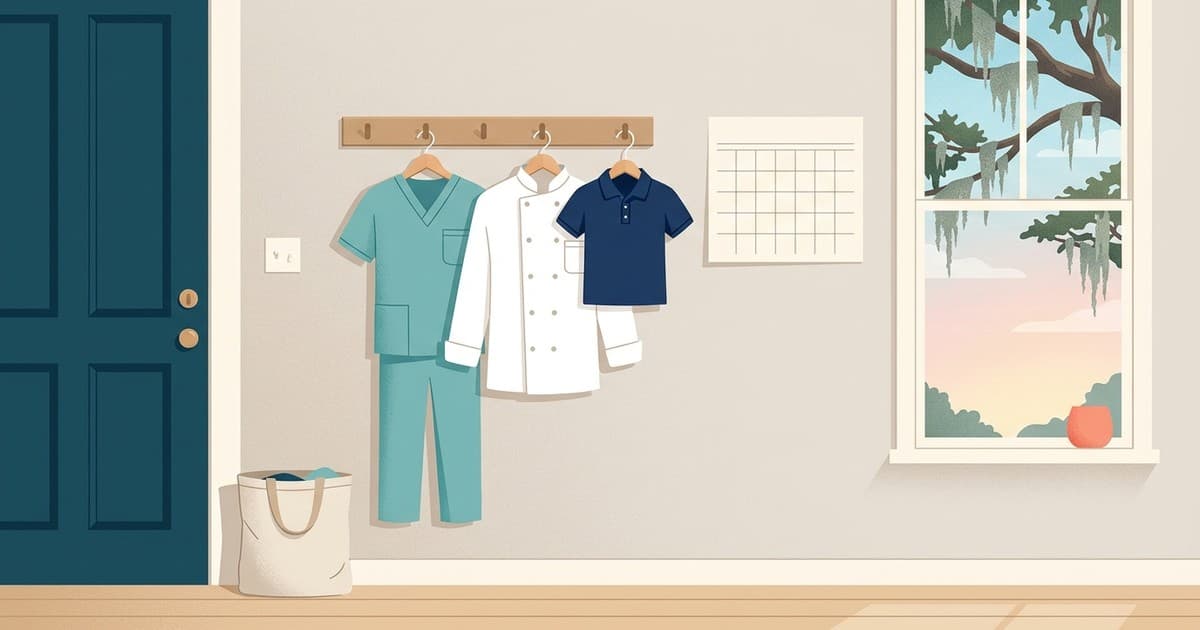
By the last week of September, every calendar in a Savannah household is full again. School has settled into its rhythm, the fall appointment season has clinics and hospital floors running at capacity, and the restaurants along the riverfront and in the Starland District are staffing up for the busiest stretch of the year. In a lot of homes across Midtown, the Southside, and out toward Pooler, that means three or four different uniforms coming through the same laundry room every week, each with its own fabric, its own stains, and its own deadline.
The complication is the weather. Late September in Savannah still behaves like summer where fabric is concerned. Afternoon highs sit in the upper 80s, humidity rarely drops below 70 percent, and a uniform that comes off a shift is damp before it ever reaches a hamper. This guide is for the dual-income families and working professionals trying to keep all of it clean at once. It covers what late-summer humidity does to work uniforms, how to sort a mixed household load by profession, and how uniform cleaning in Savannah at Best Cleaners & Laundry turns the whole thing into a once-a-week habit with volume discounts and a scheduled drop-off routine.
Why Late-September Humidity Is Hard on Every Uniform in the House
The heat itself is not the problem. The problem is how slowly anything dries. When a scrub top, a chef coat, or a polo comes off wet with perspiration and sits in a closed bag or a car trunk for an afternoon, the moisture has nowhere to go. That is the exact condition bacteria need to turn ordinary sweat into a sour odor that a home washer struggles to remove. It is also why a load that smelled fine going into the machine can come out smelling slightly off once it has been through a humid dryer cycle.
Humidity also changes how stains behave. In dry air, a coffee splash or an iodine drip sets in one spot. In Savannah's September air, that same stain stays wet longer and migrates along seams and into fibers, so by the time it reaches a washer the mark has spread. Professional treatment is still very effective at that point, but it works best when the garment arrives within a day or two rather than after a week at the bottom of a pile.
Finally, humid air wilts a pressed finish. A cotton school shirt or a poly-cotton server's shirt that looked crisp at 6 a.m. will go soft by mid-morning if it was tumble-dried and never properly finished. That is why so much of what we do for working households is about the press, not just the wash. Our Laundry & Press service sets collars and creases so they hold through a full day in the classroom or on the floor.
Sorting a Mixed Household Load: Scrubs, Restaurant Attire, and School Clothes
When one hamper holds a nurse's scrubs, a line cook's coat, and a middle schooler's khakis, the temptation is to wash everything together and hope. The fabrics disagree with that plan. Each type of uniform is built for a different job, and each one responds best to a different approach.
Medical scrubs are usually a polyester and cotton blend or a stretch synthetic, chosen for durability and comfort through long shifts. Those same blends hold onto body oils and odors once humidity has helped them soak in. Scrubs also collect the widest range of stains: iodine, adhesive residue, ink, and biological marks that need to be identified and treated individually rather than run through a generic cycle. Our medical scrubs cleaning in Savannah starts with a stain inspection on every piece so nothing gets locked in by heat.
Restaurant attire faces a different enemy. Grease, wine, sauce, and smoke settle into chef coats, aprons, and front-of-house shirts, and oil-based stains in particular behave badly in a home washer, where water alone will not lift them. Chef whites also need to come back genuinely white, which is a matter of process rather than bleach. Heavy bleaching weakens cotton and yellows synthetics over time, so we rely on controlled whitening and proper finishing instead.
School and everyday work clothes are the simplest of the three, but they are also the highest volume. Polos, khakis, and collared shirts pick up grass, ink, and lunch, and they need to look presentable every single morning. For these, our Wash & Fold service handles the bulk while Laundry & Press takes care of the pieces that need a crisp collar.
The Once-a-Week Routine That Keeps a Savannah Household Shift-Ready
The families who make this work all follow some version of the same routine. It takes a few minutes and removes most of the decision-making from the week.
- Air everything the moment it comes off. Hang scrubs and work shirts on a hook or a doorframe for an hour before they go in the bag. In Savannah's humidity, that single step does more to prevent set-in odor than any detergent.
- Keep one bag per person. A simple mesh or canvas bag for each household member means nothing gets mixed, and it makes the drop-off itself a one-trip errand. Note anything unusual on a stain, such as what it is and when it happened, so our team can treat it correctly.
- Pick a drop-off day and keep it. Most working households find that one standing drop-off, often on the way to a Monday shift or a Tuesday school run, is enough to keep every uniform in rotation. Our Waters Avenue location offers same-day service, in by 9 a.m. and out by 5 p.m., for the weeks when a schedule slips or a spare set runs out.
- Rotate a spare set. Keeping one extra set of scrubs or one extra chef coat in the closet means a late-night stain never turns into a morning emergency.
This routine works because it aligns with how our counters already run. Our team at both locations knows the households who come in every week, knows which bag belongs to the ER nurse and which to the line cook, and has the stain notes before the garments are even sorted.
Volume Discounts and Scheduled Drop-Off for Savannah's Working Households and Teams
One of the questions we hear most often in late September is whether uniform cleaning makes sense for a family rather than a business. It does, and the reason is volume. A household with two working parents and two children in school generates as many uniform pieces per week as a small clinic front office. That volume qualifies for the same volume discounts we extend to restaurants, hotels, and medical practices through our commercial dry cleaning in Savannah.
For managers and practice owners, the same logic scales up. A scheduled weekly drop-off for an entire team means every set of scrubs or every server's shirt is inspected, treated, finished, and ready on a predictable rhythm, with a single account and one point of contact. We have been doing this for Savannah's workplaces since 1910, and the structure has not changed much: a standing schedule, a consistent process, and a team that knows your garments.
If you want to know whether your household or business qualifies for volume pricing, call us at (912) 232-1171 or stop by either counter. We will walk through your weekly volume and set up a schedule that fits.
How Best Cleaners Handles Work Uniform Care in Savannah, GA
Every uniform that comes through our doors follows the same path, whether it belongs to a household or a hospital floor. Our process begins with a garment-by-garment inspection, where stains are identified by type and pre-treated with the right solvent or agent before any washing begins. This matters most for scrubs and chef coats, where a stain treated with the wrong approach can be set permanently by heat.
Cleaning is matched to the fabric. Poly-cotton blends, stretch synthetics, and heavy cotton twill each get a cycle designed for them, at temperatures that sanitize without breaking down fibers or fading color. Chef whites are whitened through a controlled process rather than aggressive bleaching, which is what keeps them bright and intact through hundreds of wears.
Finishing is done by hand where it counts. Collars, plackets, and creases are set so they survive a long shift in September's humidity, and every piece is checked one more time before it is bagged. If you are curious about the difference a proper finish makes, our guide to detailed pressing explains why a hand-finished shirt holds its shape when a tumble-dried one does not. And for the stains that show up on the way to work, our stain removal guide covers what to do in the first few minutes, and what to leave to us.
Key Takeaways
- Late-September humidity in Savannah keeps uniforms damp longer, which is what drives set-in odor, spreading stains, and wilted finishes.
- Scrubs, restaurant attire, and school clothes each need a different approach. Sorting by profession before drop-off gets better results.
- Air garments for an hour after a shift, keep one bag per household member, and pick a standing weekly drop-off day.
- Households with several uniform wearers often qualify for the same volume discounts we offer restaurants, hotels, and medical practices.
- Same-day service is available at our Waters Avenue location, in by 9 a.m. and out by 5 p.m.
Two Savannah Locations for Uniform Cleaning
Best Cleaners & Laundry has been the best dry cleaners in Savannah for working families and professionals since 1910, and late September is one of the busiest weeks of our year for exactly the reasons above. Whether you are dropping off a single set of scrubs or setting up a scheduled account for an entire team, our two counters are here to help. Find directions and hours for both locations, or stop in at either one.
Waters Ave: 1002 Waters Ave, Savannah, GA 31404. Same-day service, in by 9 a.m., out by 5 p.m. Convenient for Midtown, Ardsley Park, Thunderbolt, and the Historic District.
Abercorn: 11434 Abercorn St STE B, Savannah, GA 31419. Convenient for the Southside, Georgetown, Richmond Hill, and Pooler commuters.
Call us at (912) 232-1171 with questions about uniform cleaning, volume discounts, or setting up a weekly drop-off routine. We look forward to keeping your household, and your team, shift-ready all fall.